You’ve had a lovely day and nothing is particularly worrying you, but you have this strange feeling of being unsettled. Something just feels a little off, although you can’t quite put your finger on what it is.
When We Become Detectives of Our Own Feelings
So, you become a detective.
What could it be? Was it that thing I wish I hadn’t said? Is it because I’m so awkward and everyone secretly hates me? Is it because I’m not as successful as that person I saw on social media?
You start creating reasons for feeling a bit off, and quite possibly none of them are the reason you felt off in the first place. Before long, you have a great big list of things to beat yourself up about.
But your brain has done its job. It has given you a reason for the feeling. Who knows whether it is the right reason, but at least now you have something to fixate on.
It’s truly exhausting, isn’t it?
Do We Always Need to Know Why?
We are all so well trained to answer the question of why, that we often move away from feeling and towards facts and logic. As soon as an emotion appears, we try to explain it, rationalise it or talk ourselves out of it. We want to know where it has come from and what we are supposed to do about it.
Even when we talk to a friend about how we are feeling, I suspect many of us have been asked, “Oh, why do you think you feel like that?” It usually comes from a place of wanting to help, but does it always help?
Of course, sometimes understanding why we feel something can be useful. Being able to make sense of an emotion can help us work through something and understand ourselves more deeply. But what if we don’t always need to work it out straight away? What if it is okay to simply acknowledge a feeling and trust ourselves enough to sit with it for a while, without immediately becoming a detective?
Perhaps saying something like this to ourselves: “Oh, I’m feeling unhappy. I’ve noticed that, and I’m aware of it. I don’t know why I feel like this yet, and that’s ok.”
You could explore it in a journal or perhaps with a counsellor when you feel ready.
You may discover that another feeling is hiding underneath the unhappiness. Perhaps it is frustration, disappointment, loneliness or something else entirely.
By allowing yourself to sit with the feeling rather than immediately jumping to an explanation, you give yourself the opportunity to explore what is really going on underneath that general feeling of unhappiness.
If you jump straight to the reason, you may miss the emotion underneath the one you first noticed.
The Little Gratitude Checklist
There is something else we are remarkably good at doing when we feel unhappy, and I call it the little gratitude checklist.
We do it to ourselves and often, other people do it for us because they genuinely want us to feel better.
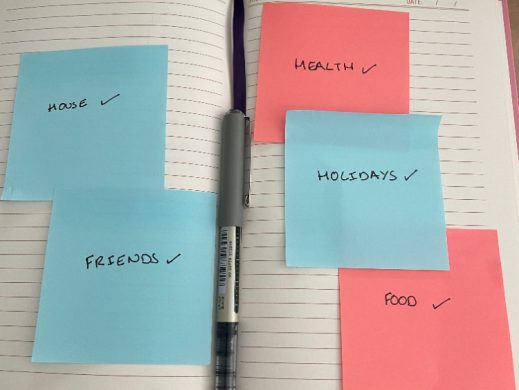
I feel unhappy, but look around me. I have a nice house, a good job and I can afford my shopping. I don’t have any reason to feel unhappy, so I need to snap out of it .
Or perhaps a friend says, “But you’re so lucky to have everything you have,” because they want to remind you of the good things in your life and help you feel better.
The problem is that you can end up dismissing your feelings because your gratitude checklist has lots of ticks. You have all the things you are supposed to be grateful for, so somehow you decide you are no longer allowed to feel unhappy.
Can We Be Grateful and Unhappy at the Same Time?
But what if it is okay to hold two seemingly conflicting feelings at the same time?
I can be grateful and feel unhappy.
I can love my life and still feel that something is missing.
I can recognise how lucky I am and still feel a bit lost or restless.
What if your unhappiness has nothing to do with all the little ticks on your gratitude checklist? By telling yourself to snap out of it, you may actually be missing an opportunity to look a little deeper and consider what is really going on for you.
What If Nothing Is Wrong?
Perhaps nothing is wrong at all. Perhaps you have simply changed and want something different. Perhaps you don’t yet know how you have changed, or what it is that you want. Perhaps, and this can be particularly difficult for those of us who like to have answers, it is okay not to know yet.
Allow yourself to sit with your feelings and to simply be with where you are right now, without rationalising everything and without immediately needing a plan.
Maybe a Little Wallowing Is Ok
For those of us who have been taught to rely on logic and to avoid “wallowing”, this can feel surprisingly uncomfortable. Who else hears their parents’ voice telling them that wallowing won’t help?
Perhaps a little wallowing is exactly what we need, or perhaps it is something we have been missing.
Exploring Your Feelings With a Counsellor
I would also encourage you to explore these feelings, because although sitting with them can be helpful, exploring them can sometimes be difficult, uncomfortable or confusing to do alone.
You don’t need to arrive with a clear explanation or know exactly what you want to talk about. You can simply start with how you feel and see where the conversation takes you.
When you’re ready, speaking to a counsellor can give you the space to do that. You don’t have to be in crisis to talk about how you feel, and you don’t need to justify investing time and attention in your own wellbeing.
Sometimes, everything really is fine. Sometimes, you are simply ready for something to change.